After improving a system once, hold the resulting system fixed and change which improver gets the next turn. That is the decisive move in MetaRSI's arXiv v2, §5.4. Both branches start from the first round's released system, S1. With the same next-round improvement budget and sealed evaluation splits, the original improver adds 4.9 average score points; the meta-updated improver adds 7.2.
The 2.3-point difference addresses a question that a rising benchmark score alone leaves open: did the previous round leave behind a more productive improvement method? Because the starting system is shared, a stronger starting system cannot explain this branch difference. The experiment tests the updated improver as a whole; it does not identify the contribution of every policy edit inside it.
Follow one capability through the system
The paper's design example gives the machinery a concrete purpose. An extension to the harness helps the system exhibit behavior it could not previously exhibit. New execution records capture that behavior. Training internalizes it into model parameters. The absorbed extension can then be retired. This is an illustration of how the mechanism can work, rather than a record of what happened in every experiment. MetaRSI v2, introduction and methods.
The sequence matters because each step changes what a later step has to work with. Records collected before the extension describe the earlier system; they cannot show the behavior enabled by the extension. Collecting evidence after the change gives the training step material from the changed system. The formulation therefore requires a fresh learning signal after any step that changes deployed behavior. Old records remain historical evidence, but they cannot substitute for that refreshed signal.
Within this example, three different objects can be edited:
| Editable object |
What changes |
Its role in the example |
| ① Running system |
Training records, model state or harness configuration |
Apply the extension, create training material or update parameters. |
| ② Proposal policy |
How an operator diagnoses failures and proposes candidate modifications |
Change how a possible harness edit or training update is proposed. |
| ③ Scheduling policy |
The rule for choosing and composing operations |
Decide the order in which extension, fresh evidence, training and retirement are attempted. |
Data-RSI, Harness-RSI and Model-RSI all act on the first row. They edit different parts of the running system. The other two rows govern how those operators propose and arrange changes. Keeping this distinction visible prevents “three operators” from being confused with “three editable objects.”
The paper assigns current operation ordering and operator-policy rewriting to RSI². After a term completes, MetaRSI² revises the scheduling policy for subsequent improvement. The harness includes prompts, memory, tools, skills and MCP-mounted resources; Model-RSI's framework permissions include bounded architectural changes. In the experiments discussed here, however, parameter training uses LoRA, so the broader permissions should not be read as demonstrated architectural rewriting. MetaRSI v2, methods and experimental setup.
This distinction also sharpens the comparison with DGM v1. DGM already lets modified coding agents produce further agents and reports beating a control that repeatedly uses the initial agent. Its archive maintenance and parent-selection process remain fixed. MetaRSI explicitly makes proposal and scheduling policies writable. That is a comparison of modification authority in the cited editions, without a head-to-head performance claim.
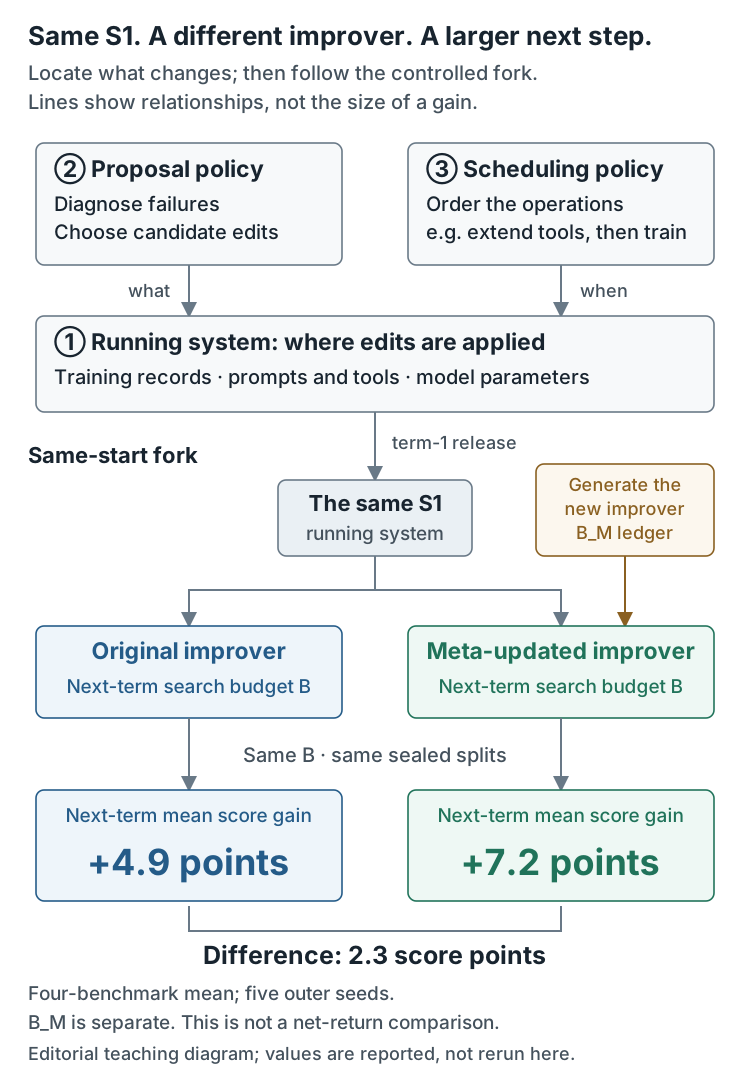
The figure connects the three edit locations to the same-S1 fork. Its lines show relationships, not gain magnitudes. The B_M input represents the separate cost of producing the updated improver; it is not folded into the two branches' shared next-round B. This is an editorial teaching diagram, with numerical values attributed to the paper.
Three gaps answer three questions
The controlled experiments use self-hosted Qwen3.5-35B-A3B. The average summarizes score gains on Terminal-Bench 2.1, SWE-bench Pro, GPQA-D-hard100 and merged 2025–2026 AIME, with numbers reported as means over five independent outer seeds under identical pass@1 settings. These are score-point gains, not relative percentages or a common scale of general intelligence. The scored object is the released successor, evaluated once per term on the sealed split. MetaRSI v2, §5.1 and Table 3.
The three prominent differences have different reference points:
| Comparison |
Reported result |
Question it addresses |
| First term, composition from S0 |
Full system: +10.9; fixed Data→Model→Harness pipeline and static router: +7.3 each. Difference: 3.6 points. |
Does scheduled composition outperform these two composition methods? |
| Second term, fork from the same S1 |
Updated improver: +7.2; original improver: +4.9. Difference: 2.3 points. |
Does the updated improver produce a larger next step from the same system? |
| Five terms, cumulative gain over S0 |
With meta-updates: +26.2; without: +20.7. Difference: 5.5 points. |
How far apart are the two improvement paths after repeated updates? |
In the first comparison, the authors describe the compositions as using the same three operators, evidence and budget, with different methods of deciding order. The static router responds to failure signatures but does not learn across terms. Its 7.3-point result and the fixed pipeline's equal result give the full system two concrete controls. MetaRSI v2, §5.2.
The second comparison moves from composition to the method left behind by a round. Both improvers inherit S1, so the 2.3-point gap more directly tests next-round productivity. The fifth-term comparison instead measures accumulated trajectories. Later rounds incorporate their paths' successive changes; the 5.5-point cumulative gap does not repeat the same-S1 isolation at every round. These differences should therefore not be ranked as three measurements of one effect. MetaRSI v2, §5.4.
What matching the next-round budget leaves out
In the fork, B fixes the resources available for the next improvement round. The framework meters tokens, elapsed time, GPU compute and verifier queries as separate resources, and the experimental controls also match operator invocations and candidate counts. B_M records the meta-improvement expenditure separately. MetaRSI v2, budget definition and §5.1.
This separates two questions. Once the updated method exists, does it extract more gain from the same next-round allowance? The reported fork answers yes, locally. Does that gain justify the expenditure used to create the method? The 2.3-point gap alone does not provide that net-return calculation. Matching the operating budget does not make the method's production cost disappear. The five-term totals likewise include a fresh allocation of B in each term, rather than five rounds of improvement purchased with one round's allowance.
The success criterion also has a boundary. Coding is checked through containerized tests; closed-form reasoning uses exact or numeric answers. On the closed-form benchmarks, harness changes are confined to the system prompt, with tool, skill and MCP slots disabled. All model-driven improvement roles use the target model itself, without stronger external-model participation or external-model training outputs, while the verifier remains environmental feedback. MetaRSI v2, experimental setup.
Under the paper's contract, the evaluator, held-out tasks, release rule and resource ledger are outside every write surface. That keeps the stated definition of success fixed during improvement. It is a measurement contract rather than an independently verified guarantee against exploitation, and coding tests or answer keys do not establish open-ended research judgment. MetaRSI v2, protected measurement.
The lead grows while the steps shrink
By term five, the meta-updated path's cumulative lead reaches 5.5 points. Yet its gain per term falls from 7.2 in term two to 1.4 in term five. The path without meta-updates falls from 4.9 to 0.7. Both statements can hold at once: a path can keep adding more than its counterpart while adding less than it did earlier. A widening accumulated lead does not require increasing marginal gains. MetaRSI v2, §5.4.
Retention supplies another bounded result. The authors report no regression on monitored held capability along the meta-updated path, while the other path loses 0.2 points on GPQA-D-hard100 at term five. This result concerns only the capabilities monitored over those five terms; it does not establish protection against every possible regression. MetaRSI v2, held-capability results.
The harness example explains why a method might improve: an extension changes the behavior available to learn from, and proposal and scheduling policies can change how that opportunity is used. The same-S1 fork supplies the local experimental answer: the updated improver produces a larger next step under the same next-round budget. Its advantage persists in the reported five-term totals, alongside diminishing per-term gains. Net returns including B_M, persistence over longer horizons and transfer beyond these tasks remain separate, unanswered questions.
Analysis using the MetaRSI arXiv v2 and DGM v1 source snapshots; the experiments were not independently rerun.